Your Cart is Empty

FREE UK DELIVERY for all Vikan Orders over £150 GBP. MOQ £70.
FREE UK DELIVERY for all Vikan Orders over £150 GBP. MOQ £70.
This section doesn’t currently include any content. Add content to this section using the sidebar.
SOS Hygiene Air socks provide a flexible and efficient solution for air distribution across commercial, industrial and specialist environments.Also known as fabric ducting, textile ducting, air dispersion systems or textile air distribution, Air Socks are designed to distribute conditioned air evenly throughout a space using a lightweight fabric system.
With over 25 years of experience, our engineering team and manufacturing partners have extensive expertise in the design and production of textile air distribution systems. This knowledge allows us to provide reliable, high-quality solutions tailored to the specific requirements of each application.
We also offer a fully flexible, bespoke manufacturing service, allowing our Air Socks to be designed and manufactured to measure. From dimensions and air volumes to outlet positions, shapes and configurations, each system can be engineered to suit the individual requirements of your space and installation.
Unlike traditional rigid ductwork, Air Socks can be engineered with different perforation patterns, outlet configurations and airflow directions to suit the requirements of individual rooms and applications. They are suitable for a wide range of environments, including warehouses, factories, sports facilities, retail premises, offices, workshops, agricultural buildings, food production areas, leisure facilities and temperature-controlled spaces.
Air Socks are textile-based air distribution systems that connect to an existing or new HVAC or air-handling system.
The fabric duct is suspended within the required space, with strategically positioned perforations or air outlets allowing conditioned air to be distributed across the room.
The system can be designed to provide different airflow patterns, from gentle air dispersion to more directional airflow, depending on the requirements of the building.
Air Socks offer a highly adaptable alternative to conventional rigid ductwork, particularly where large areas require consistent and controlled air distribution.
An Air Sock is connected to an air handling or HVAC system. Conditioned air enters the fabric duct and travels along its length.
Engineered perforations or outlets then release the air into the surrounding environment.
Air Socks for Heating & Cooling
Air Socks can be used to distribute both heated and cooled air.
In a heating application, the system can distribute warm air throughout a large space, helping reduce concentrated areas of high-temperature airflow.
For cooling applications, Air Socks can distribute conditioned air across the occupied or working area.
The appropriate outlet configuration will depend on factors such as air temperature, room height, air volume and required air velocity.
Air Socks for Ventilation
Air Socks can also be used as part of a wider mechanical ventilation system, distributing fresh or conditioned air throughout a building.
Applications can include large open spaces where conventional diffusers may not provide the desired level of air distribution.
Air Socks for Large Buildings
Large open buildings can present challenges when trying to achieve consistent air distribution.
Traditional ductwork and individual diffusers may require extensive installation, particularly where there are high ceilings or large unobstructed areas.
Air Socks can be designed as long textile distribution systems, allowing air to be introduced at multiple points across the required area.
This makes them particularly useful for large-volume spaces such as warehouses, factories, sports halls and agricultural buildings.
Industries & Applications
SOS Hygiene Air Socks can be considered for a broad range of commercial, industrial and specialist applications.
Manufacturing & Industrial
Air Socks can provide air distribution for:
Warehousing & Logistics
Suitable applications can include:
Air Socks can help distribute heated or cooled air throughout large storage areas.
Food & Beverage
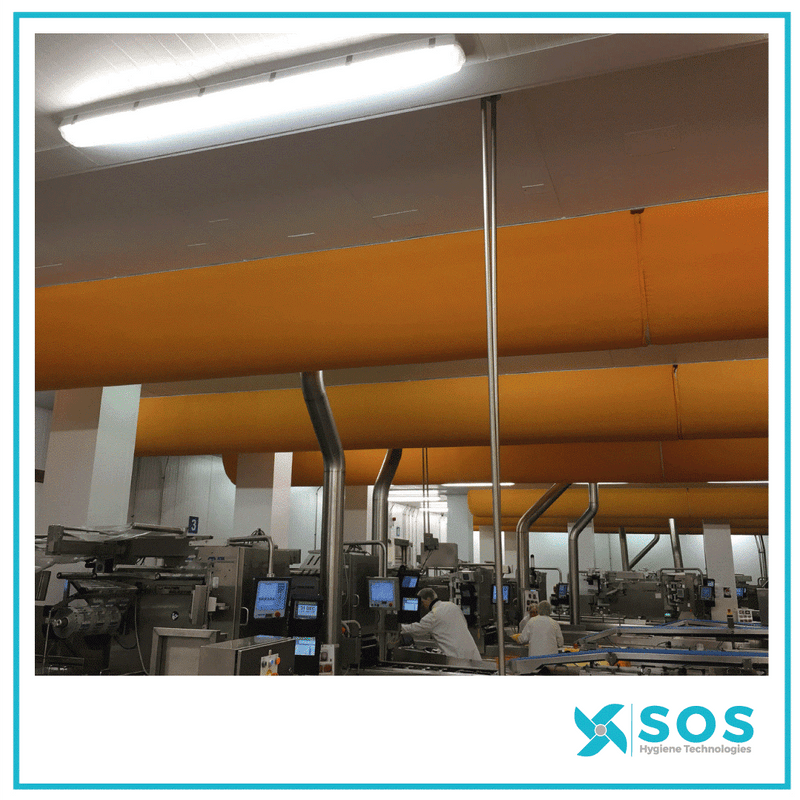
Air distribution is particularly important in food and beverage environments where temperature, humidity and environmental conditions may need to be carefully controlled.
Applications include:
Sports & Leisure
Air Socks can be used in large recreational spaces, including:
The ability to distribute air over a large area can be particularly useful where high ceilings and large occupant numbers create challenging ventilation requirements.
Retail & Commercial
Potential applications include:
Agricultural & Horticultural
Air Socks can also be considered for controlled environments such as:
System design should take account of the specific environmental conditions, contaminants, humidity and cleaning requirements of the application.
Education
Air Socks can provide air distribution solutions for:
Automotive
Suitable applications can include:
Air Socks for High & Low Ceilings
Air Sock systems can be designed for buildings with different ceiling heights.
The position of the Air Sock, outlet configuration and airflow characteristics can be engineered according to the dimensions of the room.
For high-bay buildings, careful design is particularly important to ensure conditioned air reaches the intended occupied or working zone.
Custom Air Sock Design
Air Socks are not a one-size-fits-all product.
A system can be designed around the individual building and HVAC requirements.
Design considerations can include:
This allows Air Socks to be configured for different applications rather than relying on a standard duct arrangement.
Airflow Options
Different outlet configurations can be used to achieve different airflow characteristics.
Diffused Airflow
Designed to provide a gentle and more evenly distributed air pattern across the space.
Directional Airflow
Designed to direct air towards a particular area or zone.
High-Level Air Distribution
Air can be introduced from high-level positions, with the system designed to deliver air into the required occupied or working area.
Multi-Directional Distribution
Multiple outlet positions can be used to distribute air across larger areas.
The correct configuration depends on the HVAC system, room dimensions and required environmental conditions.
Air Socks vs Traditional Ductwork
Textile air distribution can offer a number of practical benefits compared with conventional rigid ductwork.
Feature
Air Socks
Traditional Rigid Ductwork
Construction
Flexible textile
Rigid metal or other material
Weight
Lightweight
Generally heavier
Air Distribution
Configurable perforations/outlets
Fixed outlets/diffusers
Flexibility
Highly adaptable
More permanent
Installation
Lightweight suspension system
More substantial support structure
Appearance
Fabric/textile
Rigid duct
Cleaning
Removable options available
Requires access to fixed ductwork
Large Areas
Well suited to open spaces
Suitable but can require extensive ductwork
Configuration
Bespoke
Designed around fixed duct routes
The most appropriate solution will depend on the building, HVAC system, airflow requirements, budget and installation conditions.
Removable & Cleanable Air Socks
Cleaning and maintenance requirements should be considered when specifying an Air Sock system.
Depending on the fabric and system design, Air Socks can be removed for cleaning and subsequently reinstalled.
This can be particularly useful in environments where dust, fibres, grease, moisture or other contaminants may accumulate.
Cleaning requirements will vary according to the application, fabric and environmental conditions. The manufacturer's cleaning instructions should always be followed.
Air Socks for Temporary & Permanent Applications
Textile air distribution systems can be suitable for both permanent installations and certain temporary applications.
Their relatively lightweight construction can make them useful for:
The appropriate suspension and connection system should be selected according to the duration and conditions of the installation.
Air Socks for HVAC Systems
Air Socks can be integrated with suitable HVAC and air-handling systems.
Before specifying an Air Sock, the existing system should be assessed for:
This information helps determine whether the HVAC system is suitable and what Air Sock configuration is required.
Hygienic Air Distribution
In applications where hygiene is particularly important, the Air Sock specification should take account of:
This can be particularly relevant to food manufacturing, pharmaceutical, healthcare and other controlled environments.
Air Socks for Temperature Control
Air distribution is an important part of maintaining a consistent internal environment.
A suitably designed Air Sock can help distribute conditioned air throughout the target space, potentially reducing temperature variations between different areas.
Applications can include:
The Air Sock should be designed as part of the overall HVAC system rather than considered independently from the heating or cooling equipment.
Specification
Air Sock systems are project-specific, but typical specification considerations include:
Specification
Consideration
System
Textile air distribution
Application
Commercial, industrial & specialist
Diameter
Project specific
Length
Project specific
Fabric
Selected according to application
Airflow
Matched to HVAC system
Outlet Configuration
Bespoke
Connection
Matched to duct/HVAC system
Suspension
Project specific
Air Temperature
Application dependent
Cleaning
According to fabric specification
Installation
Suspended textile system
Design
Bespoke
When selecting an Air Sock system, consider the following:
Building size: What are the room dimensions and ceiling height?
Air volume: How much air needs to be distributed?
Temperature: Is the system being used for heating, cooling or general ventilation?
Airflow: Do you require gentle diffusion or directional airflow?
Environment: Will the system be exposed to moisture, dust, grease, chemicals or other contaminants?
Cleaning: Does the system need to be removable and washable?
HVAC system: What airflow and static pressure are available?
Installation: What suspension and access arrangements are available?
Providing this information allows the Air Sock system to be designed around the actual requirements of the building.
An Air Sock is a textile-based air distribution duct used to distribute conditioned or ventilated air throughout a building. It uses engineered openings or perforations to control how air enters the surrounding space.
Air Socks can be used for heating, cooling and ventilation across commercial, industrial and specialist environments, including warehouses, factories, sports halls, retail premises, agricultural buildings and food manufacturing facilities.
Yes. Air Socks can be designed to distribute heated air throughout suitable spaces, including large industrial and commercial buildings.
Yes. Air Socks can distribute cooled or conditioned air and can be configured to achieve the required airflow pattern.
In suitable applications, Air Socks can provide an alternative to conventional rigid ductwork. The suitability of the system depends on the building and HVAC requirements.
Depending on the system and fabric specification, Air Socks can be designed to be removable for cleaning. Cleaning procedures should follow the manufacturer's recommendations.
Yes. Warehouses and distribution centres are common applications for textile air distribution, particularly where large open areas require heated or cooled air.
Yes. Air Socks can be designed for sports halls, gyms and other large leisure spaces where controlled air distribution is required.
Air Sock systems are primarily designed for controlled indoor environments. Specific outdoor or semi-outdoor applications require an appropriate fabric and system specification.
Potentially, yes. The existing HVAC system needs to be assessed for airflow, pressure, temperature and connection requirements before an Air Sock is specified.
Air Socks can be configured around the requirements of individual projects, including length, diameter, outlet arrangement, fabric and connection.
Service life depends on the fabric, environment, operating conditions, cleaning regime and maintenance. The expected lifespan should be discussed as part of the system specification.
Professional installation is recommended to ensure the system is correctly suspended, connected and matched to the HVAC system.
Sign up to get the latest on sales, new releases and more …